


Since birth, your baby’s sleep rhythm evolves. Nights often become more regular, but naps can sometimes seem unpredictable or difficult to establish. Why are naps hard to put in place? How many naps does your baby need? How can you help them fall asleep quickly?
Naps for babies from 7 months to 1 year: let’s take a closer look.
What are the benefits of naps for a baby from 7 months to 1 year?
Naps offer multiple benefits that are essential for your baby’s healthy development:
- They allow for physical and mental recovery.
- They help ease tension and promote a more stable mood.
- They support memory, strengthen concentration, and make learning easier.
Want to learn more? Feel free to download the May app, where you’ll find plenty of resources to support and guide you throughout your journey as a new parent.
Why are naps difficult to establish?
Throughout a baby’s first year, it is very common for nighttime sleep to be easier while naps remain challenging.
In reality, daytime sleep is not biologically straightforward, for several reasons:
- Your baby’s body produces cortisol during the day. This hormone, involved in alertness and activity, does not promote falling asleep.
- Their body temperature is higher during the day, which also does not help with sleep.
- Melatonin, the hormone that helps with falling asleep, is mainly secreted in the dark, therefore at night.
- During this period, your baby becomes more independent and their desire to explore the world—especially by crawling—often takes over.
- This phase can also be accompanied by sleep regressions, often linked to early teething as well as increased sensitivity during separations from attachment figures. Some babies may cry at the moment of separation.
Getting your baby to sleep during the day can therefore sometimes be challenging. 
Should you force a baby who doesn’t want to nap?
It is not recommended to impose naps rigidly. However, a quiet break remains essential, even if your child does not fall asleep right away.
Sleep needs vary from one child to another. However, the ability to fall asleep often depends on the environment. A calm and reassuring setting makes it easier to accept rest time.
Moreover, a baby showing signs of drowsiness may paradoxically be very agitated. In this case, the need for rest is real even if it is expressed through refusal. The nap then becomes a necessary way to help them relax and come down from a state of excessive stimulation.

When can my baby transition to 2 naps?
Starting at 6 months, naps become more regular. Between 7 months and 1 year, the rhythm is often three naps per day: one in the morning, one in the early afternoon, and one in the late afternoon. It is usually around 1 year old that the transition to two naps happens. Gradually, the sleep cycle changes and your child may drop one of the afternoon naps. The morning nap, for its part, usually disappears around 18 months. 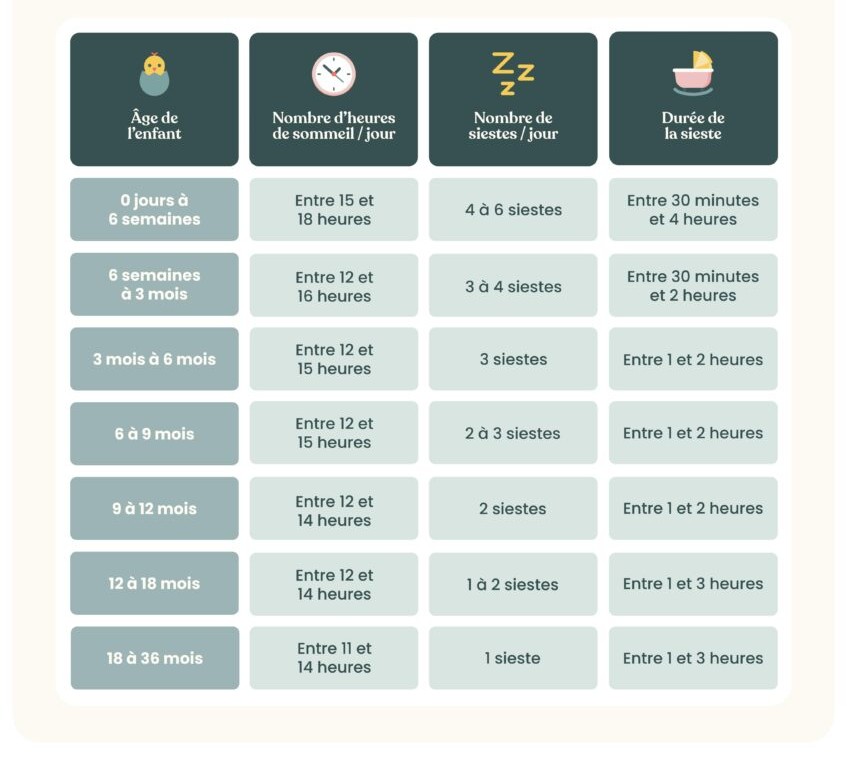
How can I help my baby fall asleep quickly?
It is not always easy to get a baby to sleep, especially when you notice signs of fatigue (crying, restlessness…) but they are unable to fall asleep.
In general, falling asleep is easier when your child has built up enough tiredness, meaning their awake time has been long enough and they feel a certain “sleep pressure.” Be sure not to wait too long to put them down once you notice the first signs of fatigue.
When you want your child to nap during the day, it is recommended to avoid complete darkness during the first months so they do not confuse this sleep period with bedtime at night.
You can continue your normal daily activities, as this helps your baby understand that it is a short rest period and allows you to establish sleep habits together. Once nighttime sleep is well established, you can make the room darker and introduce more rituals around naps (bottle, reading a story, cuddles…), as your child will then see these as additional signals that it is time to rest.
In summary, naps for babies from 7 months to 1 year play an important role in physical, emotional, and cognitive development. Every child develops at their own pace: some will need three naps for longer, while others will transition more quickly to two. The key is not to follow a strict model but to observe your baby, recognize their signs of fatigue, and provide a reassuring environment to help them fall asleep.
Photo credit: seventyfourimages | nadiasaleh86 | AnnaStills | hectorfoto
This text was translated from French by an artificial intelligence. The information, advice, and sources it contains comply with French standards and may therefore not apply to your situation. Make sure to complement this reading by visiting the May US/UK app and consulting the healthcare professionals who are supporting you.