


Pregnancy Timeline
–

Awake time is closely linked to babies’ sleep periods. A good amount of sleep allows a 4-month-old baby to be particularly active during their awake periods. Conversely, sufficient awake time helps your baby sleep well. How can you organize awake time according to your baby’s sleep?
Awake time for a 4-month-old baby: let’s take a closer look.
At 4 months, your baby is building strength. They can hold their head up better, push up on their arms while on their tummy, and sometimes begin to roll over. Awake time is essential to support these motor skill milestones. To stimulate their sight, touch, and hearing, you can:
However, you remain their main focus of interest: your face, your voice, and your presence provide the richest stimulation.
Good to know: during awake periods, it is important to offer your baby different positions, especially by regularly placing them on their tummy, always under supervision. This helps prevent flat head syndrome, known as plagiocephaly.
Want to learn more? Feel free to download the May app, where you’ll find plenty of resources to support and guide you throughout your journey as a new parent.

Between 3 and 6 months, your child’s sleep evolves. Around 4 months of age, their daily and sleep rhythms become more regular. Their sleep cycles reach about 70 minutes, compared to 50 minutes when they were under 2 months old.
Sleep gradually begins to include phases of light and deep sleep, although your baby continues to fall asleep in active sleep (REM sleep). It is only from 6 months onward that deep sleep accounts for more than 50% of total sleep time.
A 4-month-old infant sleeps more as their biological clock begins to align with a 24-hour cycle. As a result, the day/night pattern becomes clearer, and they are better able to stay asleep, especially at night.
Lack of rest can cause drowsiness or, conversely, crying that is difficult to soothe. Establishing a bedtime routine also helps your baby sleep through the night and sleep in their crib. On average, a 4-month-old baby needs 15 to 16 hours of sleep per day.
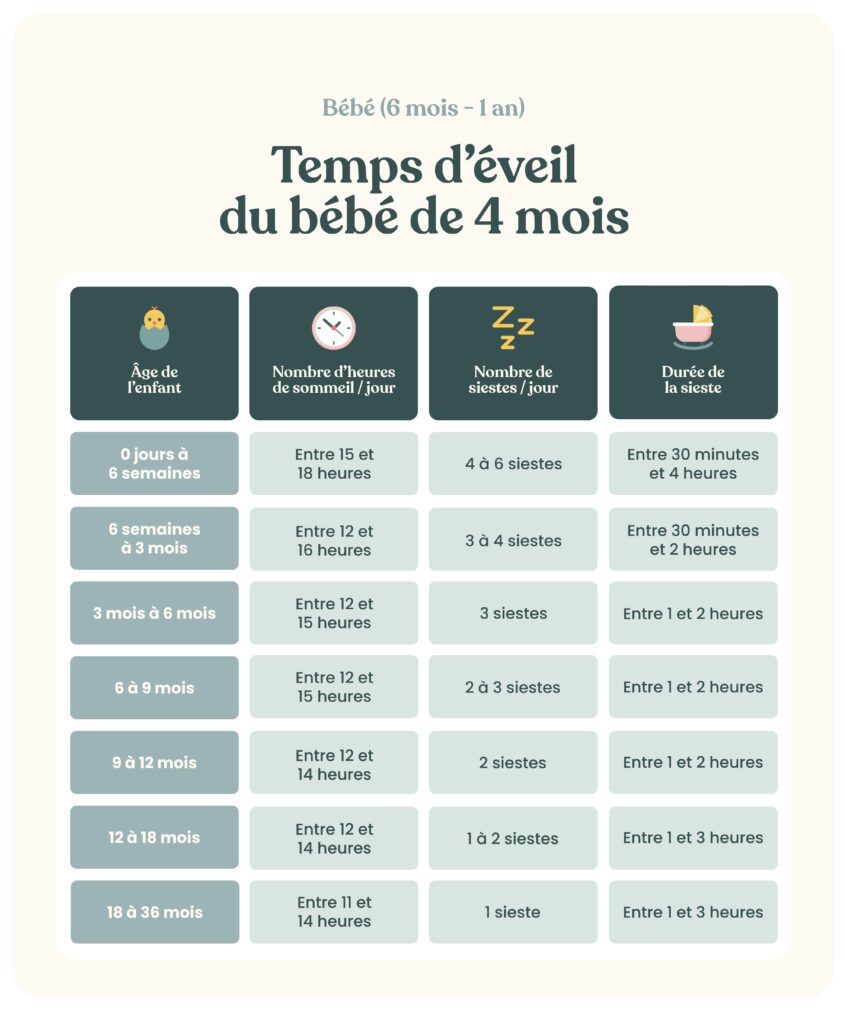
Here is the awake time between each nap depending on your baby’s age. These figures are provided for guidance only and may vary from one child to another:
At 4 months, your baby takes about 4 to 5 naps per day, lasting from 30 minutes to 2 hours, and has 1 to 2 hours of awake time between each nap.
Since awake time is very important for your baby’s proper development, it is essential that your child is well-rested and therefore gets enough sleep. Here’s how to recognize the signs of sleep deprivation and address it if necessary.
The accumulation of the following signs may indicate a lack of sleep in your baby:
To address this lack of sleep, several adjustments can be made:

At this age, it cannot be said that babies fully sleep through the night, but many are able to sleep continuously between 11 p.m. and 5 a.m. without waking. Indeed, sleep and wake rhythms are no longer based solely on hunger or fullness, as the infant begins to have sufficient energy reserves to feel less hungry at night.
If your baby wakes between two sleep cycles, we recommend waiting a few minutes before picking them up or soothing them, as it is likely that they will fall back asleep very quickly, if not immediately after waking.
The development of wakefulness also influences infant sleep. During this period, nights may be more restful for you as your baby becomes tired during the day. In fact, days are more active as your baby is constantly seeking new discoveries despite signs of fatigue. As you can see, every baby is different. Every parent hopes their child will sleep through the night as soon as possible.

From 4 months onward, your baby will gradually move toward a well-defined daily routine with 3 naps during the day: one in the morning, one in the afternoon and one at the end of the day. They wake up after each nap, and these moments make up their awake periods.
These awake periods may be longer or shorter depending on your baby’s age. At 4 months, your baby reaches a new milestone. They develop further in several areas (language, understanding of their environment, motor skills, sensory awareness, etc.) and respond more to your stimulation.
During awake time, feel free to offer developmental games (books with different textures, colorful toys, etc.) and tell stories using puppets, as your baby enjoys the sound of your voice. Bath time can also be a moment of play and bonding between parents and children.
Good to know: at 4 months old, awake time is just as important as sleep time. If your baby sleeps a lot but tends to be very active during awake periods, there is no need to worry! They are probably a heavy sleeper! So don’t hesitate to respect your baby’s sleep needs.

The 4-month sleep regression has no scientific explanation but is sometimes observed by parents when there is a sudden deterioration in sleep around 4 months. This regression is often difficult for parents who thought their baby had mastered sleep.
However, sleep regression is a sign of development in infants. Sleep regressions occur at different stages in childhood. They often appear after a change in the child’s life (disrupted sleep habits, change of environment, new developmental milestones, etc.).
At 4 months, they can be explained by the development of wakefulness. Indeed, your infant may go through an important relational development phase that drives them to become more alert and want to discover the world around them. During this period, awakenings may be more frequent, especially during naps, as they want to quickly return to interacting with their environment. Similarly, they may wake more often at night because their sleep is lighter, much to parents’ dismay.
In summary, at 4 months, your baby’s awake time and sleep are closely linked and evolve rapidly. Awake periods not only support motor, sensory, and emotional development but also promote better-quality sleep. By carefully observing their sleep cues, maintaining regular routines, and offering rich yet calming awake experiences, you help them gradually find their balance.
**
Photo credits: nenetus | valuavitaly | yavorandriy | Image-Source
This text was translated from French by an artificial intelligence. The information, advice, and sources it contains comply with French standards and may therefore not apply to your situation. Make sure to complement this reading by visiting the May US/UK app and consulting the healthcare professionals who are supporting you.
Some of the links below may no longer be active. In that case, please feel free to refer directly to the relevant websites.
These resources might interest you