


Baby Feeding
–

Created by your body specifically for pregnancy, the placenta provides the vital link between you and your developing baby. How does the placenta form? What does the placenta look like, and what is its role throughout pregnancy? Here is an overview.
The placenta forms in the uterus, at the same time as the fetus. Since your baby can neither eat nor breathe inside your womb, this organ is essential to its development. It delivers the nutrients and oxygen your baby needs.
That is not all, it also plays an important role as a filter (it does not filter everything, but a great deal; this is known as selective filtering), has an important hormonal secretion function that helps maintain pregnancy, and also plays a role in immune tolerance (meaning it prevents your body from rejecting the fetus, which is technically a foreign body).
Want to learn more? Feel free to download the May app, where you’ll find plenty of resources to support and guide you throughout your pregnancy.
In the final phase of cell division, after the meeting of the egg cell and the sperm cell, the cluster of cells divides into 2 distinct masses:
The cells of the baby and the placenta therefore have the same DNA.
At the very beginning of pregnancy, the cells that will form the placenta surround the embryo. This outer layer is called the trophoblast.
It is a little later, only toward the end of the 3rd month of pregnancy (12 weeks of amenorrhea), that we speak of the “placenta”: the trophoblast cells migrate to one pole of the egg to form the chorion, and then the placenta itself.

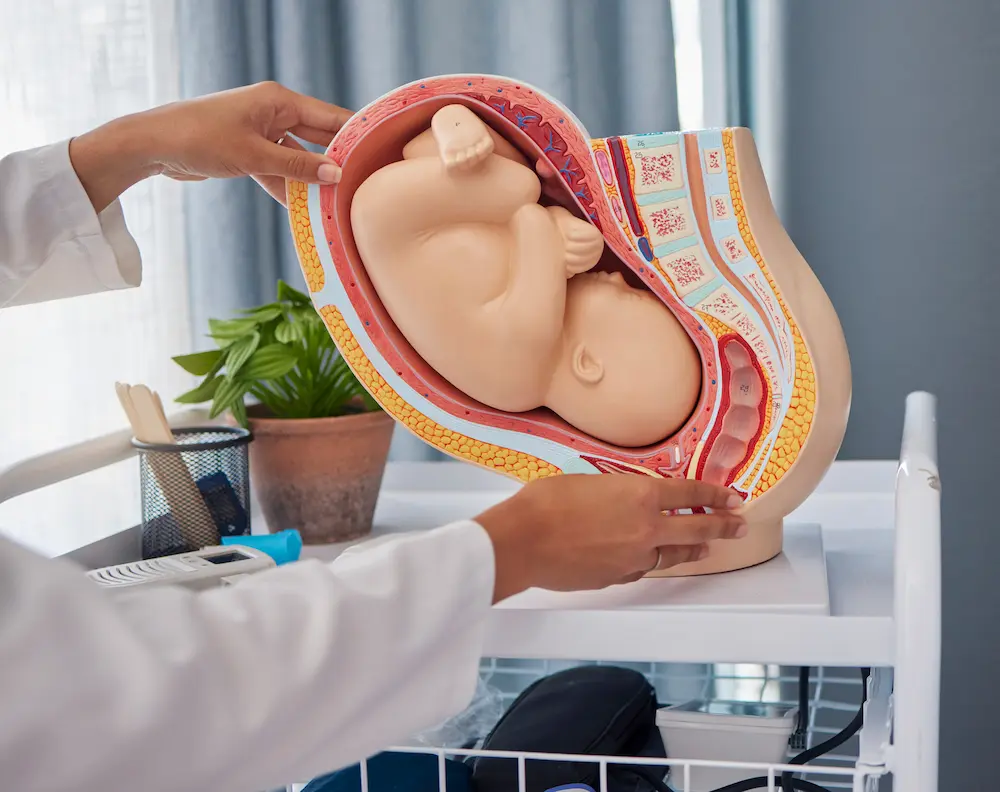
To give you a concrete idea, the placenta is a disc with two sides: one faces the uterus and is attached like Velcro to the uterine lining, called the endometrium, and the other faces the baby and is covered by the amniotic membranes. This is the side where the umbilical cord attaches.
In terms of weight, it changes throughout pregnancy : before 16 weeks of amenorrhea, the placenta weighs more than the fetus. At 16 weeks, it weighs the same as the fetus. At 28 weeks of amenorrhea, it weighs one quarter as much as the fetus and at term, it weighs one sixth as much as the fetus (that is 500 g for a 3 kg baby).
It may be located at the front, back, left, or right side of the uterus… it does not matter! There is only one place where it is not ideal to find it: in front of the cervix, the baby’s exit.

It is important to know that the placenta, an essential organ during pregnancy, may not function or develop properly. The consequences can be significant for you and your baby but there are ways to manage these situations. Among the possible complications, here are the most common ones.
This is when the placenta partially or completely covers the cervix. This condition can cause heavy bleeding during pregnancy and childbirth, or even preterm birth. A C-section may be scheduled, especially if the placenta completely covers the cervix. Rest assured, this is a relatively rare situation, as it affects very few pregnancies.
Placenta previa increases the risk of hemorrhage during pregnancy, especially during the third trimester. Bleeding may occur suddenly, usually without pain, and requires prompt medical evaluation.
Placenta previa can also make vaginal delivery difficult, or even impossible if the cervix is completely covered. Starting at 32 weeks of amenorrhea, the distance between the edge of the placenta and the internal opening of the cervix is measured precisely. This information helps determine the most appropriate mode of delivery. Rest assured, in the vast majority of cases, a placenta that is initially low-lying during the second trimester moves upward spontaneously as the uterus grows.
When the placental edge is located more than 20 mm from the internal opening, vaginal delivery may be considered, provided there is no bleeding or other contraindications.
If the placenta is partially or totally covering the cervix, or is located less than 20 mm from it: a planned C-section is recommended, often between 36 and 38 weeks of amenorrhea, in the absence of hemorrhage.
Preeclampsia is placental dysfunction that presents with high blood pressure and protein in the urine. In France, according to data from the national health insurance system, preeclampsia occurs in around 2% of pregnancies. The challenge of this condition is the risk of sudden and serious complications for the mother and/or the fetus.
Placental insufficiency occurs when the placenta does not work as it should and exchanges are not optimal. Intrauterine growth restriction is then possible because the baby may not receive everything needed. Regular monitoring of the fetal heart rate, as well as the baby’s well-being on ultrasound, is then necessary.
Other complications are also possible such as placental abruption, placenta accreta, or placenta increta (abnormally deep implantation)… Risk factors that may favor the development of these problems include advanced maternal age, a history of placental complications, smoking, multiple pregnancy, diabetes…
If health problems related to the placenta, which remain rather rare, are identified during your pregnancy, rest assured, you will then be closely monitored by your healthcare professionals (midwife, gynecologist, obstetrician, etc.) to minimize the risks. Your health and your baby’s health are paramount, and appropriate medical follow-up will then be put in place.
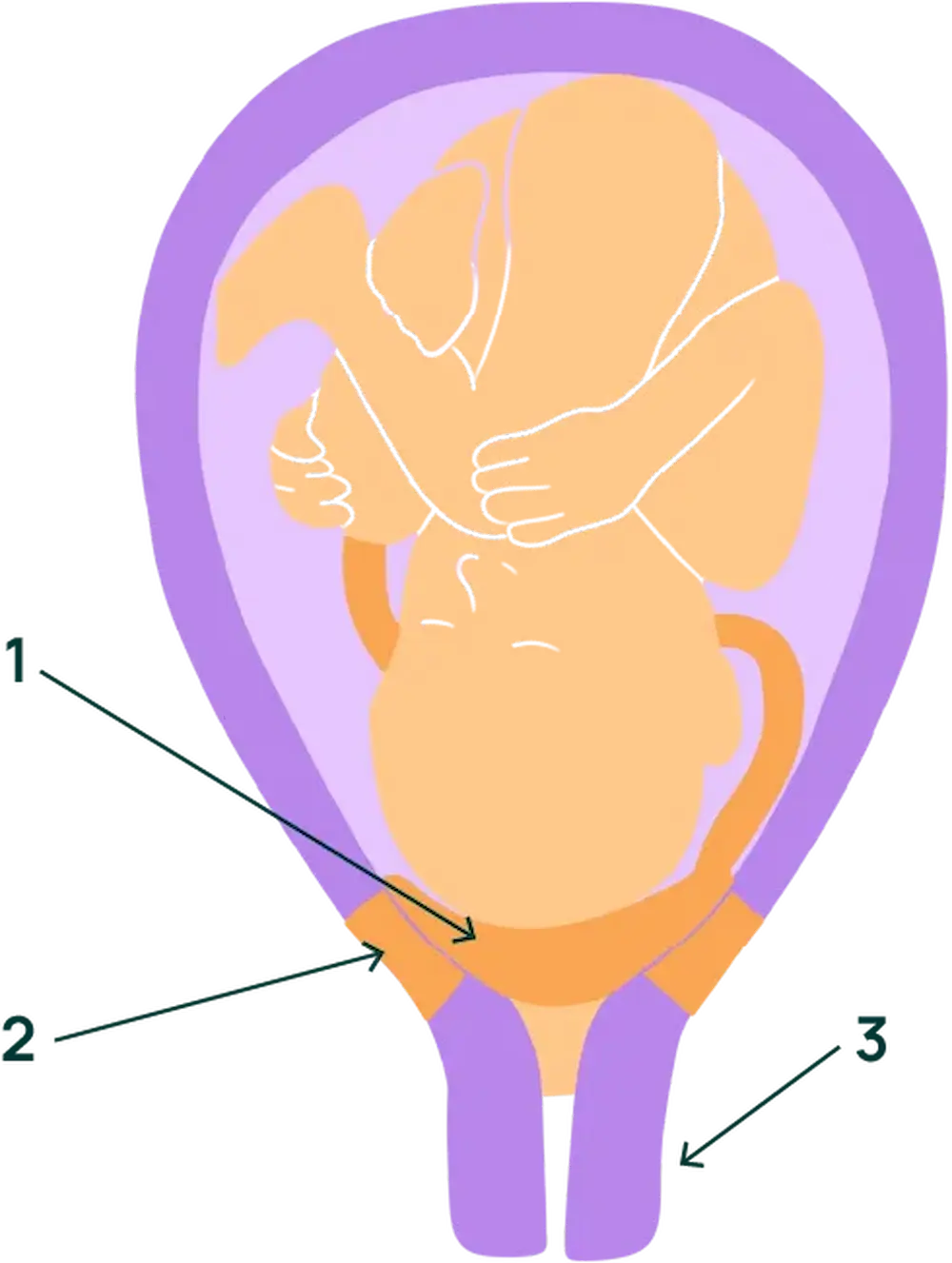
1 – Placenta
2 – Lower uterine segment
3 – Cervix
Fortunately, placental problems can be diagnosed in various ways. Placenta previa, for example, can be identified by ultrasound.
As for preeclampsia, protein in the urine is checked for. A urine test each month is used to look for it. Blood pressure is also measured at every prenatal follow-up appointment to check for hypertension, one of the main symptoms of this condition.
You should seek medical advice if you notice signs of high blood pressure such as:
As for intrauterine growth restriction, an ultrasound can also detect a baby’s small size. In addition, Doppler ultrasound can measure whether blood flow in the umbilical cord is sufficient and therefore whether exchanges between the fetus and you are taking place optimally. 
The placenta is connected to the fetus by the umbilical cord. As explained a little earlier, it is on the side of the placenta that faces the fetus that oxygen and essential nutrients are transferred from your body to the fetus, ensuring proper development through the cord. During the prenatal period, it also produces the hormones necessary for the smooth progress of pregnancy.
Conversely, again thanks to the cord, fetal blood carries waste products (such as carbon dioxide produced by respiration and metabolic waste) to your body, which will take care of eliminating them. The placenta and the umbilical cord complement each other.

After your baby is born, the uterus continues its work. The contractions that resume after birth eventually detach the placenta (it is similar to pulling apart Velcro, and this is what then causes postpartum bleeding), and the following contractions allow it to be expelled.
You are still giving birth, but this time to the placenta. The expulsion of the placenta is also called the delivery of the placenta, a name that fits perfectly… Once the placenta has been expelled, childbirth is finally over and the postpartum period officially begins.
The placenta can come out without outside help, thanks to uterine contractions. In the majority of maternity units (indeed, likely all of them, as this is a national recommendation), a dose of oxytocin is nevertheless usually injected after the baby is born to support proper placental delivery.

In France, it is theoretically forbidden to keep your placenta, which is most often destroyed at the maternity unit. After childbirth, there are in fact only two possibilities regarding the placenta’s future under the provisions of the public health code. Either it becomes surgical waste and must follow the incineration procedure provided for all infectious healthcare waste. Or it is kept for scientific or therapeutic purposes with your consent.
Some women, especially in the United States, wish to eat their placenta, for its symbolic and nutritional virtues. As for the latter, no study has demonstrated them, but regarding symbolism, of course, that is up to each individual. Moreover, consuming the placenta could even present a health risk: let us not forget that it served as a barrier against many germs and toxins during pregnancy.
In some cultures, the placenta is considered the child’s twin, which is quite accurate from a tissue point of view! That is why some families bury the placenta and plant a tree directly above it.
Good to know : some hospitals (especially those that include a French Blood Establishment center) offer, subject to eligibility criteria, the possibility to donate cord blood. Cord blood is collected from the umbilical cord immediately after the child’s birth. It is characterized by containing stem cells that are very useful for treating blood diseases, which are most often cancers such as leukemia or lymphoma. You can find more information on dondemoelleosseuse.fr.
In summary, your body creates the placenta only for pregnancy. Yes, you are capable of creating an organ, no less! It ensures your baby’s proper development by passing along the food you eat and the air you breathe. The placenta is therefore an essential organ that creates the very first bond between you and your child.
**
Photo credits: YuriArcursPeopleimages | Nastyaofly | klingsup | Media-photos | leszekglasner | inshyna
This text was translated from French by an artificial intelligence. The information, advice, and sources it contains comply with French standards and may therefore not apply to your situation. Make sure to complement this reading by visiting the May US/UK app and consulting the healthcare professionals who are supporting you.
Some of the links below may no longer be active. In that case, please feel free to refer directly to the relevant websites.
These resources might interest you

Negative blood test but no period : understanding the causes