


Practicing skin-to-skin contact with your baby turns out to be an activity with many benefits. It is increasingly recommended and commonly done right after your baby is born in the maternity ward and during the months that follow.
Skin-to-skin contact with your baby: here’s everything you need to know.
What is skin-to-skin?
Skin-to-skin means placing your baby naked against someone else’s bare chest. Generally, it’s against your own chest, whether you are the mother, father, or co-parent. It can even be practiced with the baby’s siblings.
This practice dates back to the 20th century, in 1978, in Bogotá, Colombia. At that time, a maternity ward did not have enough incubators for every premature baby. The idea was born: keep babies warm against the bodies of their parents and family members 24/7 by taking turns. Improvements in the health and development of newborns were observed.
Since then, there has been the Kangaroo Mother Care (KMC) program for premature newborns, which recommends skin-to-skin contact 24/7, breastfeeding every 1.5 hours, parental support workshops, and the possibility of an earlier discharge.
This practice has become widespread around the world. In France, most maternity wards encourage skin-to-skin contact. From this program came the term Kangaroo Units in French maternity wards: mothers are hospitalized there with their newborn who breathes on their own but has feeding difficulties or needs care.
The benefits of skin-to-skin
For all babies
Skin-to-skin contact has numerous benefits. This is why many pediatricians recommend it (and would even be willing to prescribe it!). At birth, skin-to-skin contact allows for:
- transitional sensory continuity (the baby regains familiar cues such as your scent, the sound of your voice, or your heartbeat),
- improved well-being and behavior in the newborn, who feels safe (which provides reassurance),
- early interactions and facilitation of the establishment of the parent-child bond,
- facilitating the establishment of breastfeeding,
- effective maintenance of the baby’s body temperature, better metabolic adaptation, cardio-respiratory stability, and an analgesic effect (less pain)
After birth, there are also many benefits when continuing skin-to-skin contact:
- When curled up against you, your baby can regroup more easily (for example, the Moro reflex decreases).
- Sleep time increases and is calmer.
- Crying decreases.
- Breastfeeding duration increases and sucking improves: these are facilitated by sensory stimulation (smell and touch).
- Your baby reacts to your face thanks to mirror neurons.
- Strengthening of the parent-child attachment creates closeness and enjoyment of the shared moment.
- In case of a fever: skin-to-skin contact may help regulate their body temperature.
For premature babies
For premature babies, skin-to-skin contact is just as beneficial — in fact, it can be considered real care for them. The benefits are almost identical to those mentioned for full-term babies. Skin-to-skin is even more recommended for premature babies because it provides many advantages:
- stabilization of their cardio-respiratory functions,
- better temperature regulation and fewer episodes of hypothermia,
- better weight gain.
Want to learn more? Feel free to download the May app, where you’ll find plenty of resources to support and guide you throughout your journey as a new parent.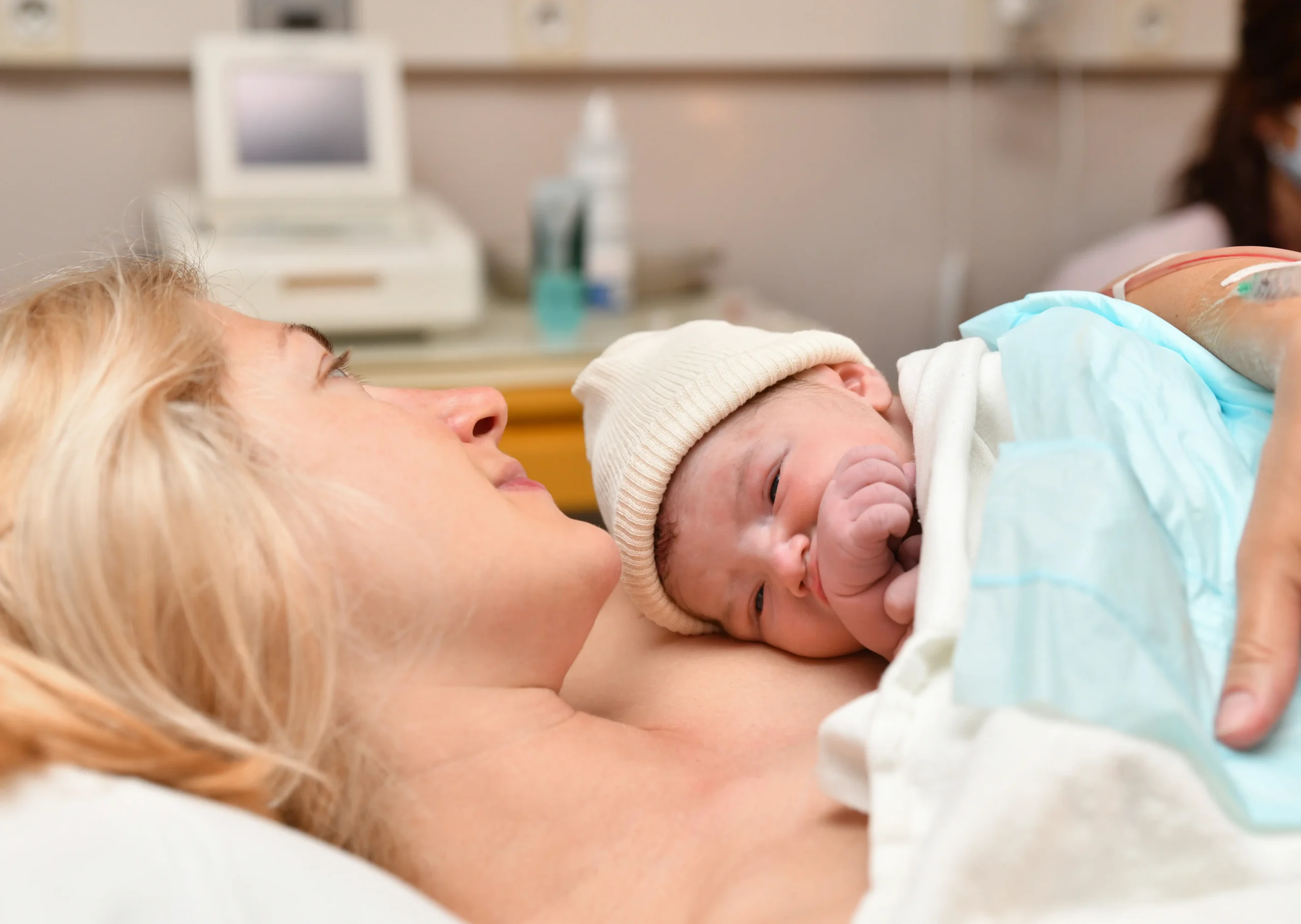
Practicing skin-to-skin
At the maternity ward
At the maternity ward, skin-to-skin contact with your baby is offered right after birth. If the mother cannot do it immediately — after a cesarean birth, for example — the father or co-parent can take over (don’t hesitate to ask the medical team, who is usually very supportive). You can even specify it in your birth plan. Moreover, the World Health Organization (WHO) has recommended since 1999 to “Place the newborn in skin-to-skin contact with the mother immediately after birth for at least one hour and encourage the mother to recognize when her baby is ready to breastfeed, providing help if needed.”
At home
At home, you can also practice skin-to-skin contact with your baby. Here are some tips for proper positioning:
- make sure you are upright but sitting comfortably,
- your baby’s head should be turned to the side, face unobstructed, nose and mouth clear, and neck not bent,
- you can cover them with a large swaddle or a skin-to-skin wrap, or use a light blanket,
- to be more comfortable, you can also use a breastfeeding pillow.
Note that this is not a babywearing technique — you should not stand up while doing it.
At home, you can practice skin-to-skin at different times:
- if your baby is unsettled,
- if they have trouble falling asleep,
- if you are experiencing a drop in milk supply,
- simply for the joy of the moment.

Skin-to-skin contact with a premature baby
During a hospital stay, especially with a baby who needs medical care like a premature newborn, the medical team is there to support and reassure you. If you are encouraged to do skin-to-skin, it means you can do so safely. Skin-to-skin is even more recommended for premature babies because despite the medical environment (intensive care, hospitalization, resuscitation…), it allows you to reassure your baby and stay close. How does skin-to-skin work with a premature baby?
- A healthcare provider will help you get positioned with all the cables, tubes, IVs… The goal is for you to be comfortable and your baby safe.
- Plan ahead (bathroom break, etc.) because this moment can last a long time.
- Wear comfortable clothing that opens easily so you don’t get cold.
How long should skin-to-skin last?
There is no time or age limit for practicing skin-to-skin contact. It can last as long as you want, as long as you and your baby are comfortable and your baby is stable (or does not need to return to an incubator for premature babies). In most cases, you will be the one who needs to move. If you practice skin-to-skin at the hospital with a premature baby, expect about 45 minutes to 1 hour.
You can also practice skin-to-skin several times a day depending on your child’s rhythm and fatigue. And if you don’t want to, that’s completely okay too! You’ll have plenty of other opportunities to cuddle and comfort your baby.
Once your baby is dressed or out of the incubator (for premature babies), you can continue these moments of skin-to-skin after a bath, for example. It can also be helpful to keep practicing at home to make the transition and adaptation to your child’s new environment and life easier. 
Is skin-to-skin beneficial for parents too?
Absolutely — skin-to-skin has significant benefits for you as parents. In addition to reinforcing the attachment bond with your baby, it gives you time and space to find your place as a parent. It strengthens your sense of competence. Your confidence may improve simply by observing your baby and getting to know them.
If you are breastfeeding, skin-to-skin helps increase oxytocin production (which plays an essential role in releasing milk). It also makes latching easier for your baby (as they are stimulated by the sensory closeness to your chest).
For co-parents, skin-to-skin right after birth is an opportunity to create a relationship during your baby’s very first moments of life. It also reassures your baby, who has just arrived in an entirely new environment.
For parents of premature babies, skin-to-skin can help reduce the trauma of birth and delivery. You can better follow the weeks of interrupted pregnancy. You may also regain confidence by seeing and touching your baby more closely. Finally, skin-to-skin provides moments of cuddles and tenderness after separation from the incubator.
Skin-to-skin can therefore be soothing and comforting, beneficial for both babies and parents. It is increasingly practiced for its many advantages and also recommended in cases of prematurity. So if you feel like doing it, don’t hold back! **
**
Crédits photos : rohaneh | o1559kip | deriabinanatalia | nanihta | jorditudela
This text was translated from French by an artificial intelligence. The information, advice, and sources it contains comply with French standards and may therefore not apply to your situation. Make sure to complement this reading by visiting the May US/UK app and consulting the healthcare professionals who are supporting you.