


Développement bébé
–

Properly bottle-feeding your baby is something you learn over time. During the first months of life, a few simple habits can be helpful in preventing discomfort such as stomach aches or reflux… Here are 5 tips for properly bottle-feeding your baby.
Adopting the right method for bottle-feeding your baby is very important to limit digestive issues. By making sure the nipple is always filled with milk, allowing your baby to regulate the milk flow thanks to a horizontal bottle position, and offering regular breaks for burping, you help prevent them from swallowing too much air while promoting more comfortable digestion.
Similarly, the way the bottle is prepared is very important for promoting good digestion. Be sure to follow the recommended dilution, namely one scoop of powdered milk for 30 ml of water, which is best suited for digestion. In addition, we strongly recommend giving milk portions adapted to your baby’s weight and age, in order to avoid giving too much milk, which could lead to regurgitation due to an overly full stomach. Follow the advice of your healthcare professional!
Finally, don’t hesitate to warm the milk if digestion seems uncomfortable, or even discuss with your child’s doctor or nurse the choice of milk if your baby experiences significant digestive issues. Before talking about the correct position for bottle-feeding, it is important to remember that the WHO recommends breastfeeding during the first six months of your baby’s life. Indeed, breast milk is tailored to an infant’s needs and offers many benefits.
Whatever your choice (which is entirely yours!), this article applies equally to breast milk and powdered milk when given in a bottle. Want to learn more? Feel free to download the May app, where you’ll find plenty of resources to support and guide you throughout your journey as a new parent. 
The right position for bottle-feeding your baby is not always easy to adopt. Here are the key points to remember:
First of all, take the time to get properly settled to protect your back. Ideally, sit in a comfortable chair rather than standing. You can also add cushions if needed to support the arm holding your baby. This step is the foundation of good positioning.
Next, it is recommended to hold your baby close to you in a semi-upright position. Also make sure their limbs are relaxed, their head is supported, and that they do not need to turn it to drink. Even as your baby grows and starts holding the bottle on their own, don’t hesitate to continue holding them in your arms to enjoy the closeness this bonding moment provides. You can alternate sides from one feeding to the next to stimulate your baby’s development and vision in a balanced way.
It is recommended to offer the bottle nipple to your baby’s lips and wait until they open their mouth. Also, hold the bottle slightly horizontal, making sure the nipple is always filled with milk while allowing your baby to regulate the flow themselves. Be careful: if you hold the bottle vertically, the milk will flow on its own and too quickly. 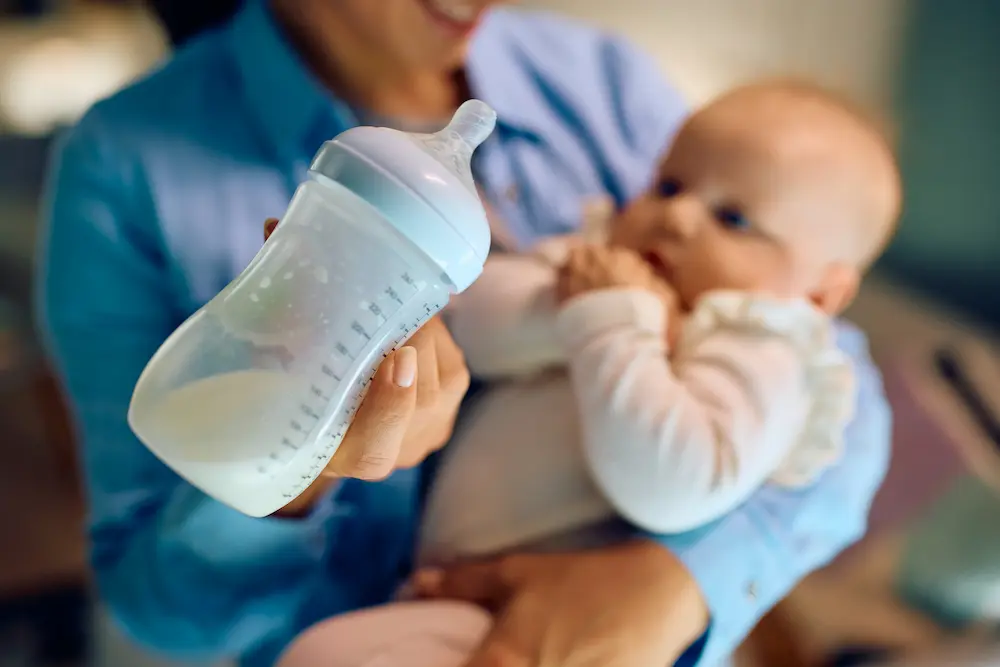
When bottle-feeding your child, it is best to choose a calm place, in a fairly quiet room with dim lighting. From 3–4 months of age, it can be helpful to avoid external stimulation around you, as your child may become easily distracted from their meal and take longer to finish the bottle. 
It is important that the flow rate is appropriate so your baby has enough sucking time, providing a feeling of fullness and optimal digestive comfort. You can expect between 15 and 20 minutes per bottle in total. It is also important to offer regular breaks so your child can burp if needed and release the air they have swallowed. To do this, place your baby upright against your shoulder or sitting facing you, and gently pat their back. 
Several criteria can guide your choice when selecting a bottle, starting with the material. Glass bottles are heavy but natural, recyclable, and offer excellent thermal stability. To prevent breakage, reinforced versions or silicone sleeves are now available. Plastic bottles, on the other hand, are appreciated for their lightness and practicality, although they wear out faster. Since 2010, all models sold in Europe are BPA-free (a synthetic estrogen).
Finally, silicone bottles, more recent and more expensive, appeal due to their flexibility and durability. Capacity evolves with your child. Small 150 ml bottles make early measurements easier, while larger 250 ml formats meet your baby’s growing needs—there is no need to buy larger ones. The shape also affects ease of use.
Cylindrical, angled, or ergonomic, bottles should be chosen based on grip and ease of cleaning, a crucial factor especially if you use a dishwasher. Finally, the nipple deserves special attention. Silicone, durable and transparent, suits most babies, while rubber, which is more flexible, helps those with weaker sucking.
Manufacturers offer many options, including flat shapes, soft textures, or anti-colic valves that facilitate air circulation. Whatever nipple you choose, it must be compatible with the bottle and replaced regularly. Despite all recommendations, it is often the baby who ultimately decides which bottle and nipple suit them best. 
A few precautions remain essential to ensure your baby’s food safety. Tap water can be perfectly suitable for preparing your baby’s bottles. Let the water run for a few seconds, avoid contact between the bottle neck and the tap, and use cold, unfiltered water to reduce microbial risks. It is also advisable to check with your local municipality that the water meets standards for nitrates, pesticides, and heavy metals.
More eco-friendly than bottled water, it remains ideal if it meets these criteria. If tap water is not suitable, bottled water labeled “suitable for infant feeding” is recommended. Once opened, it should be consumed within 24 hours and stored in the refrigerator. When traveling or in case of doubt, boiled and cooled water remains a safe option. Infant formula requires special attention. Frequent changes are best avoided, as babies adapt poorly to variations in taste or texture.
The formula container must be properly stored, tightly closed, used with a clean measuring scoop, and consumed within four weeks after opening. In terms of hygiene, bottles no longer need to be sterilized after each use. However, thorough washing remains essential. All parts should be disassembled, cleaned with a bottle brush and dish soap, rinsed, and air-dried.
A dishwasher can be used, provided the items are rinsed beforehand and silicone nipples are chosen. Before starting food diversification, it is possible to estimate the daily amount of milk needed using the Appert rule, which is based on your baby’s weight (weight in grams / 10 + 250). This total amount is then divided by the number of bottles planned for the day to determine the volume of each. Keep in mind that an infant’s appetite is not constant. It may vary from one meal or day to another. This calculation therefore remains an indication rather than a perfectly precise measurement. Preparing the bottle follows a few simple steps:
Good to know: ready-to-use sterilized liquid formulas are also available. Once opened, they must be stored in their original container, refrigerated between 32°F and 36°F (0–2°C), and consumed within a maximum of 48 hours. In conclusion, since every baby has their own rhythm, a few adjustments may be necessary.
You may need to change the nipple flow rate, adjust the milk temperature, or wait patiently during temporary refusal due to fatigue, teething, or illness. Beyond the technical aspect, these meals are true moments of bonding. They nourish the body as much as the emotional connection, creating precious moments in your daily life and that of your child.
**
Photo credits: AnnaStills | drazenphoto | dekddui1405 | wavebreakmedia | nenetus
This text was translated from French by an artificial intelligence. The information, advice, and sources it contains comply with French standards and may therefore not apply to your situation. Make sure to complement this reading by visiting the May US/UK app and consulting the healthcare professionals who are supporting you.
Some of the links below may no longer be active. In that case, please feel free to refer directly to the relevant websites.
These resources might interest you

Armpit pain during pregnancy: causes, symptoms, and solutions