


How can bronchiolitis in infants be treated?

Written by Pierre Kadlub
Updated on 26 January 2026
Baby Health
4 minutes

Share the article

Bronchiolitis is a respiratory infection caused by a virus, most often the respiratory syncytial virus (RSV), which affects the bronchioles (small airways) of the lungs. Bronchiolitis is a contagious disease. Each year, it affects 30% of children under 2 years of age, mainly between October and March. Although generally mild in most cases, bronchiolitis can lead to serious complications. It is therefore important to know how to identify and manage bronchiolitis, and above all to recognize warning signs. Dr. Emmanuelle Rondeleux, pediatrician at May, explains what you need to know about bronchiolitis in this article.

How to recognize bronchiolitis?

Bronchiolitis affects children under 2 years old. The first symptoms of bronchiolitis (usually during the first 3 days) resemble those of a common cold, namely:

  • stuffy nose,
  • runny nose,
  • sneezing,
  • mild fever (38.5°C / 101.3°F or lower).

These symptoms are usually accompanied by a cough. Bronchiolitis is characterized in particular by frequent coughing fits, which may be associated with congestion in the airways, faster breathing, and wheezing. In the vast majority of cases, symptoms may worsen during the first 2 days, then gradually improve from day 5 onward and disappear within 8 to 10 days (although the cough may last up to 3 weeks). However, if your infant shows symptoms of bronchiolitis, we recommend consulting your doctor promptly to confirm the diagnosis. Want to learn more? Feel free to download the May app, where you’ll find plenty of resources to support and guide you throughout your journey as a new parent. How to treat bronchiolitis in infants? - May Health App

How is bronchiolitis transmitted in infants?

Bronchiolitis is a seasonal infection that usually appears around mid-October and disappears at the end of winter. Its peak intensity is generally observed between November and December. The virus spreads very easily from one person to another, particularly through:

  • saliva,
  • coughing,
  • sneezing.

It can also survive on hands and on various everyday surfaces or objects (toys, pacifiers, stuffed animals, etc.), thereby promoting transmission. How to treat bronchiolitis in infants? - May Health App
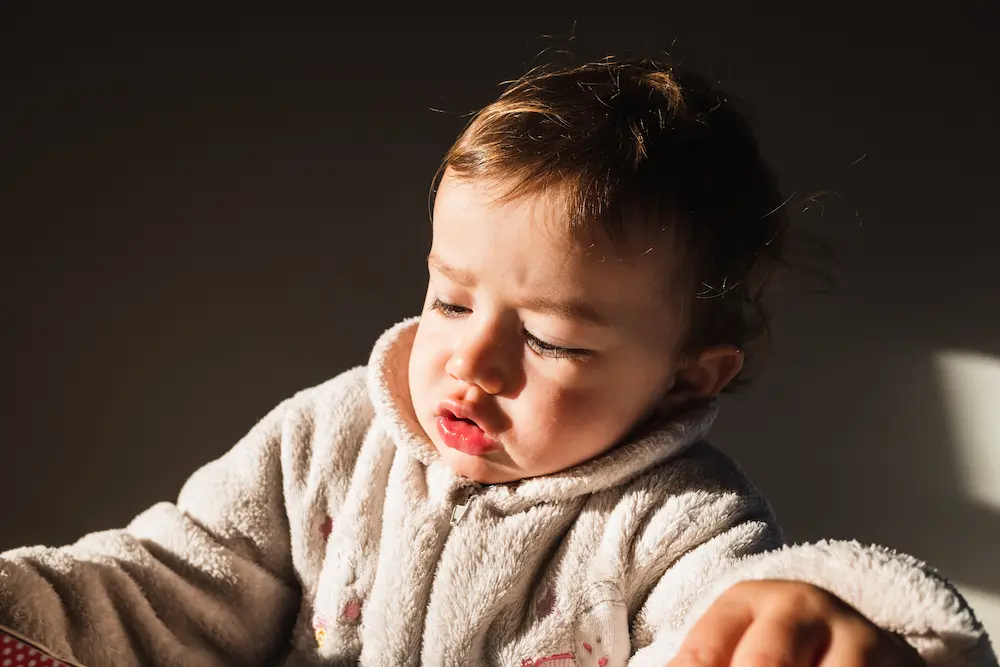
Your baby has symptoms of bronchiolitis: what to do

In most cases, no medication is required to treat bronchiolitis. However, it is essential that your child is not struggling to breathe. Treatment is primarily based on measures aimed at limiting airway obstruction caused by mucus and improving breathing comfort. Therefore, if your child has bronchiolitis, we recommend the following measures: Regularly clean your baby’s nose. This is not a pleasant moment for you or your baby, but it is effective. To do this, use saline solution single-dose vials or, after 9 months, a nasal spray:

  • Starting position: lay your child on their back or side.
  • Gently but firmly hold their head to one side (they may not enjoy what comes next…)
  • Place the pipette or spray at the entrance of the nostril, aimed toward the back.
  • Gently press or spray.
  • Wait a few seconds. The goal is achieved if the solution comes out through the other nostril.
  • Repeat on the other side.

Ideally, repeat this before each feeding and before bedtime. If your baby has severe nasal congestion, you can do it as often as necessary. Offer fluids frequently, if needed, oral rehydration solutions such as ADIARIL© or VIATOL© can help thin bronchial secretions and prevent dehydration. Split your baby’s feedings. Breathing difficulties often make feeding harder. It is therefore important to take your time: do not hesitate to pause during feedings. You can also offer smaller feedings (or bottles) more frequently. Relieve fever. If your baby has a fever (temperature above 38.5°C / 101.3°F), you may give acetaminophen (be sure to follow the correct dosage based on weight and allow 6 hours between doses). How to treat bronchiolitis in infants? - May Health App
Your baby has symptoms of bronchiolitis: what not to do

Certain practices can worsen bronchiolitis symptoms or pose risks to infants. Here are the practices to avoid:
  • Do not give cough medicines or bronchial thinners: they are ineffective in infants with bronchiolitis and may even be dangerous.
  • Do not place your baby on their stomach to sleep: this position does not improve breathing and increases the risk of sudden unexpected infant death (SUID). The recommended position is on the back, on a firm mattress.
  • Do not smoke near your baby: tobacco smoke, even in small amounts, irritates infants’ fragile airways. Passive smoking, including smoke residue on clothing or in the environment, increases the risk of complications.
  • Avoid self-medication: antibiotics are not indicated for bronchiolitis because it is a viral infection. Only a healthcare professional can decide to prescribe treatment in case of complications.

How to treat bronchiolitis in infants? - May Health App

Infant bronchiolitis: warning signs

Closer monitoring is required if your baby has bronchiolitis.

If your baby is in one of the following situations, consult a doctor within 24 hours:

  • Your baby was born prematurely and/or had breathing problems at birth.
  • They have a chronic illness.
  • Your baby eats less than usual (less than half of what they normally eat or drink).
  • They have digestive issues: vomiting, diarrhea.
  • Your baby has difficulty breathing or their breathing rate seems faster than usual (> 40 breaths per minute).
  • You have already consulted a doctor but symptoms are worsening, or after a few days the fever increases and bronchial secretions appear thick, yellow, or greenish, or your baby seems to have ear pain: a bacterial superinfection is possible.

In some cases, it is necessary to take your baby directly to the emergency room:

  • Your baby is under 6 weeks old.
  • Under 3 months old and was born extremely premature (before 34 weeks of pregnancy).
  • Your baby refuses to eat or drink, or vomits after every bottle.
  • Has a respiratory, cardiac, or neuromuscular condition.
  • Their behavior changes (they sleep much more than usual or, conversely, cannot fall asleep, show whining or decreased muscle tone).
  • They are increasingly struggling to breathe: breathing is rapid (> 60 breaths per minute) and shallow or irregular and slow, they pause between breaths, or show signs of respiratory distress (flaring nostrils, belly rising, retractions between ribs and above the collarbones).

After recovery, some infants may experience new episodes of bronchiolitis during future outbreaks. From the 3rd episode accompanied by wheezing, this is referred to as infant asthma. Blood tests and chest imaging may then be necessary.

As always, take your child to the emergency room if you notice any of the following:

  • Behavioral changes: your child is lethargic or drowsy, irritable, not behaving as usual, sleeps a lot, and is difficult to wake.
  • Skin color changes: very pale, dark circles under the eyes, sunken eyes, mottled skin, or bluish lips.
  • Breathing issues: difficulty breathing or pauses in breathing.

How to prevent bronchiolitis in infants?

A few hygiene measures can reduce the risk of infection during outbreaks, or at least the risk of recurrence:

  • Wash your hands (and those of your other children) before touching your infant, or use an alcohol-based hand sanitizer.
  • Do not kiss your baby on the face if you have a cold. Likewise, if you are sick, it is preferable to wear a mask when caring for your baby.
  • If possible, avoid taking your baby out during the first months to crowded and confined places, such as public transportation or supermarkets.
  • Ventilate your home regularly (at least 10 minutes per day) and avoid overheating rooms (19–20°C / 66–68°F is sufficient).
  • Do not share pacifiers, bottles, or utensils with other children.
  • Wash toys and stuffed animals frequently.
  • Regularly clean your baby’s nose in case of upper respiratory infection.
  • Keep your child at home during bronchiolitis, as attending daycare or group settings during the acute phase promotes virus spread.
  • Do not smoke in the presence of a child.

To reduce the risk of RSV infection, two options are available during the virus circulation period:

  • Vaccination during pregnancy: it can be administered between 32 and 36 weeks of gestation with the Abrysvo® vaccine, unless it has already been given during a previous pregnancy.
  • Direct protection of the infant: your baby may receive the monoclonal antibody Beyfortus®. It is administered in the maternity ward for babies born from September 2025 onward, or by a doctor or midwife if the baby was born after February 1, 2025.

In summary, bronchiolitis is a common respiratory infection, most often mild, but it requires close attention, especially in infants. Knowing how to recognize early symptoms, adopting the right daily habits, and avoiding inappropriate practices generally allows effective home recovery. If in doubt, never hesitate to consult your healthcare professional. ** Photo credits: maxbelchenko | joaquincorbalan | Image-Source | puhimec This text was translated from French by an artificial intelligence. The information, advice, and sources it contains comply with French standards and may therefore not apply to your situation. Make sure to complement this reading by visiting the May US/UK app and consulting the healthcare professionals who are supporting you.


Links and references

Some of the links below may no longer be active. In that case, please feel free to refer directly to the relevant websites.

Bronchiolite du nourrisson. M. Fuger et coll. , EMC Médecine d’Urgence , vol. 13, N°2, juin 2018.

Bronchiolite aiguë du nourrisson. A. Deschildre et coll. ARch Pédiatr 2000; 7 Suppl 1 : 21-6.

These resources might interest you